Value chains and food wasteFood and rural economy
Why food processing plants close in Canada, and what keeps others open
Food processing is Canada's largest manufacturing industry, yet well-known plants still close. What decides which ones shut, which stay, and which get a second life.
 By Navdeep Grewal9 min read
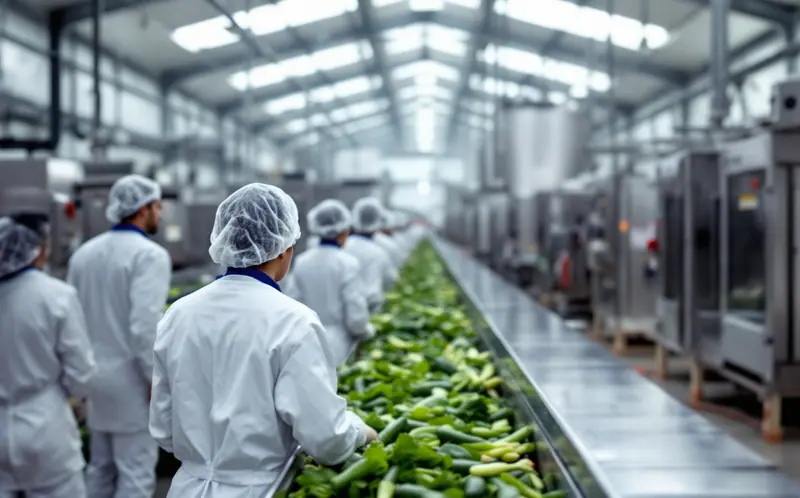
In a town with one big food plant, everyone knows the shift change. The parking lot fills, the coffee shop gets busy, the trucks line up on the side road. When the plant announces it will close, the news travels faster than any press release, and the questions start straight away. Why here? Why now? Was it the dollar, the owners, the age of the building, or something the town could have done?
Those questions have no single answer, but the economics behind them are fairly consistent. This piece looks at the size of the industry, three well-known Ontario closures, the forces that push a plant toward closing, the forces that keep one open, and how some closed plants get a second life. A worked example at the end shows why volume matters so much.
A large industry made of many plants
Food and beverage processing is Canada's largest manufacturing industry. According to Agriculture and Agri-Food Canada, it was the largest by value of production in 2024, with sales of goods of $173.4 billion, about 20 per cent of all manufacturing sales. It was also the largest manufacturing employer, with about 318,400 jobs. Exports of processed food and beverages reached a record $59.8 billion that year.
The industry is spread across about 8,800 establishments with employees, and most of them are small: around 92 per cent have fewer than 100 employees, and under 1 per cent have more than 500. Ontario and Quebec together account for about 60 per cent of sales. So when people talk about plant closures, they usually mean the large plants, which are few in number but employ a big share of the workers and buy a big share of the farm products.
Three closures that people still talk about
Heinz in Leamington
In November 2013, H.J. Heinz announced it would close its tomato processing plant in Leamington, Ontario, along with two plants in the United States. About 740 full-time jobs were affected in Leamington, and the plant was set to stop operating in June 2014. For growers in Essex County, who had supplied processing tomatoes to the plant for generations, the loss was also the loss of their main buyer.
Kellogg in London
In December 2013, Kellogg announced it would close its cereal plant in London, Ontario, by the end of 2014, with about 500 jobs lost. The closure was part of a global restructuring that consolidated production in fewer, larger factories. The plant had operated for about 75 years. Its last shift ran in December 2014.
Campbell in Toronto
In January 2018, Campbell announced it would close its soup plant in the west end of Toronto, which had opened in 1931. About 380 manufacturing jobs were affected, and soup and broth production ended in phases by mid-2019. The company said the plant's size and age meant it could not be retrofitted in a way that would be competitive, and it pointed to more production capacity than it needed.
| Plant | Announced | Jobs affected (approx.) | Reasons reported |
|---|---|---|---|
| Heinz, Leamington | November 2013 | 740 | Part of a wider network consolidation |
| Kellogg, London | December 2013 | 500 | Global restructuring, cereal sales |
| Campbell, Toronto | January 2018 | 380 | Plant size and age, surplus capacity |
The common thread is that none of these plants closed because nobody in Canada wanted ketchup, cereal or soup. They closed because their owners, looking at a network of plants across North America, decided the volume could be made more cheaply somewhere else.
What pushes a plant toward closing
Scale
Most food processing has high fixed costs. A plant needs buildings, cooking and cooling equipment, a packaging line, wastewater treatment, sanitation crews and quality staff whether it runs one shift or three. A plant that runs at full capacity spreads those costs over many units. A plant that runs half full does not. When a company has more capacity than it needs, the smallest or least-used plant is usually the first to go.
Plant age
Old plants were built for old products and old ways of working. Multi-storey buildings, narrow docks and outdated layouts make it hard to install modern high-speed lines. Food safety and environmental rules change, and an old building may need heavy spending just to stay compliant. When the cost of rebuilding is close to the cost of building new, owners often compare the old site with every other site they could choose.
Consolidation into larger US plants
Under free trade between Canada and the United States, a plant in one country can supply both markets without tariffs on most processed foods. A multinational with plants on both sides of the border can concentrate production in its largest and newest facilities and serve Canadian shoppers by truck. The Canadian market is about a tenth the size of the US market, so the largest plants are more often on the US side.
The exchange rate
A strong Canadian dollar makes production in Canada more expensive compared with production in the United States. Between about 2011 and 2013 the Canadian dollar traded close to par with the US dollar, which squeezed Canadian plants that sold in competition with US output. A weaker dollar works the other way, but plants are long-lived decisions, and owners rarely reverse a closure because the currency moves.
Labour
Food plants need reliable workers for repetitive and often cold or wet jobs, frequently in small towns. Shortages raise wages and overtime, and high turnover adds training costs. Many meat and seafood plants rely partly on workers who come through federal temporary foreign worker streams, which our earlier piece on temporary foreign workers describes. Labour costs rarely close a plant on their own, but they can tip a marginal decision.
What keeps a plant open
Close to its supply
Some raw materials do not travel well. Fresh milk, live animals, ripe tomatoes and fresh vegetables lose value fast, so plants that process them tend to sit close to the farms. That is a strong anchor. The location logic for meat plants, and the trade-off between moving animals and moving meat, is set out in a page on where hogs are raised and processed.
Supply-managed inputs
Dairy processors in Canada buy milk produced under supply management, and high over-quota tariffs limit imports of most dairy products. A cheese or yogurt plant that wants to sell to Canadian shoppers therefore has strong reasons to stay in Canada, because its raw material is Canadian and imported finished product faces those tariffs. The same broad logic applies to poultry and egg processing. That does not guarantee any single plant's future, but it shapes where the industry's capacity sits.
Specialised products
Plants that make something hard to copy, such as a regional product, a specialty ingredient or a short-shelf-life item that must be close to the customer, compete less on unit cost alone. A bakery making fresh bread for nearby stores, or a plant making products for a particular ethnic or religious market, has a reason to exist where it is.
Reinvestment
The best predictor that a plant will still be open in 10 years is that someone has recently spent money on it. New lines, automation and energy upgrades reduce cost per unit and give the owner a reason to keep using the asset. Plants that have not seen investment for a long time are often the ones on the shortlist when a network review comes.
Relationships with growers and customers
Plants with long-term supply arrangements and close ties to their customers are harder to move. A grower base that plants to the plant's schedule, and a retailer or food-service buyer that values a local supplier, both add value that a distant plant cannot easily replace. The piece on value chain collaboration describes how those arrangements work.
A second life: how closed plants reopen
A plant that closes still has buildings, equipment, a trained local workforce and nearby farms. For a new owner, that can be cheaper than building from scratch.
Leamington is the best-known example. In 2014 a new Canadian company, Highbury Canco, took over the former Heinz plant and kept processing tomatoes there, initially with about 250 jobs and seasonal workers, far fewer than the 740 lost. Part of the arrangement was that it would pack products for Heinz under contract for a time. The new owner had to find its own customers to fill the plant over the longer term.
The pattern is common. A new owner often starts smaller, runs fewer lines, takes contract packing work to fill capacity, and builds its own business over several years. Success depends on the same factors as before: enough volume, a cost structure that works at that volume, and buyers willing to commit.
A worked example: cost per unit at different volumes
The numbers below are round and purely illustrative. They describe no real plant.
Picture a vegetable cannery with fixed costs of $12 million a year: depreciation on buildings and equipment, management, maintenance, sanitation, insurance and property taxes. Its variable costs, meaning raw vegetables, cans, energy, direct labour and freight, come to $0.60 a case. Its capacity is 20 million cases a year.
| Cases produced | Fixed cost per case | Variable cost per case | Total cost per case |
|---|---|---|---|
| 20 million (full) | $0.60 | $0.60 | $1.20 |
| 15 million | $0.80 | $0.60 | $1.40 |
| 10 million | $1.20 | $0.60 | $1.80 |
| 5 million | $2.40 | $0.60 | $3.00 |
Now suppose the same company has a larger, newer plant in another country that makes the same product at $1.10 a case delivered, including the cost of trucking to Canada. If demand drops and the Canadian plant falls from full capacity to 10 million cases, its cost rises from $1.20 to $1.80 a case. The gap with the other plant widens from 10 cents to 70 cents a case. On 10 million cases, that is $7 million a year.
At that point, closing the smaller plant and running the larger one harder looks attractive on paper, even after severance and closure costs. Not closing it would mean finding more volume, cutting fixed costs, or investing in equipment that lowers the variable cost, and each of those has a price. This is the arithmetic behind many closure announcements, including those that cite overcapacity.
The example also explains why reopened plants often survive at a smaller size. A new owner may buy the plant at a fraction of its original cost, which cuts the depreciation charge and so the fixed cost per case. A plant that could not compete at $12 million of fixed cost may work at $5 million.
What the numbers suggest
For communities and growers, the useful questions about a local plant are fairly concrete. How full is it? When was it last upgraded? Does its owner have larger, newer plants elsewhere? Does it depend on raw material that must be processed nearby? Does it make something specialised, or a standard product that could be shipped from anywhere? Plants that score well on those questions tend to stay, whatever the dollar does. Plants that score poorly are at risk even in good years. Grocery prices and margins add another layer to this, covered in a separate piece on grocery margins in Canada.

Navdeep Grewal
Navdeep is from Abbotsford, British Columbia, where his family grew berries. He covers food prices, grocery retail and food processing, with a weakness for unit-price labels.