Food and rural economyFarm business
Temporary foreign workers on Canadian farms: how the programs work
From the 1966 Jamaica agreement to today's Agricultural Stream: how farms hire seasonal workers from abroad, the rules on wages and housing, and the criticisms.
 By Colette Ranville8 min read
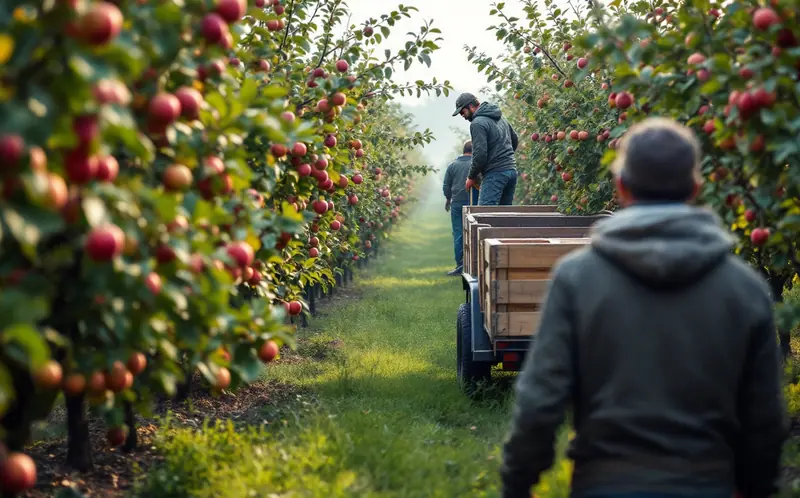
Drive through the greenhouse belt around Leamington, the orchards of the Okanagan or the vegetable fields south of Montreal in midsummer and you will see crews of workers who arrived in Canada a few months earlier and will leave before winter. Many have come back to the same farm for years. Without them, a large share of Canada's fruit, vegetables, flowers and mushrooms would not be picked, and some livestock barns would be short-handed.
Temporary foreign workers are now a fixed part of Canadian agriculture. Statistics Canada counted 79,734 of them employed in the agriculture sector in 2023, up 23.3 per cent from the year before. Against the 280,798 agricultural employees counted that year, that is roughly 28 per cent. The programs that bring them are older and more complicated than most people realize. This piece explains how they work, what the rules say about wages and housing, what critics and farm employers each argue, and how an ordinary season unfolds.
A program that began with one country
The Seasonal Agricultural Worker Program, known by its initials SAWP, began in 1966 with an agreement between Canada and Jamaica. The first group of a few hundred Jamaican workers came to help Ontario growers through the harvest. Trinidad and Tobago and Barbados joined soon after, Mexico followed in 1974, and the states of the Eastern Caribbean in 1976.
From the start, SAWP was built as an agreement between governments. The sending country recruits and selects workers, and its consular staff in Canada, known as liaison officers, act for the workers during the season. Employers use a standard contract that cannot be modified, signed by the employer, the worker and the foreign government's representative.
Today SAWP is open to citizens of Mexico and 11 Caribbean countries: Anguilla, Antigua and Barbuda, Barbados, Dominica, Grenada, Jamaica, Montserrat, St. Kitts-Nevis, St. Lucia, St. Vincent and the Grenadines, and Trinidad and Tobago.
The streams in plain terms
Employment and Social Development Canada groups farm hiring under what it calls the primary agriculture stream of the Temporary Foreign Worker Program. Inside that stream there are several routes. The two that matter most are SAWP and the Agricultural Stream.
| Feature | Seasonal Agricultural Worker Program | Agricultural Stream |
|---|---|---|
| Who can be hired | Citizens of Mexico and 11 Caribbean countries | Citizens of any country |
| How workers are recruited | Through the sending country's government | Through the employer, often with a recruiter |
| Length of stay | Up to 8 months, between 1 January and 15 December | Can be longer than a single season |
| Contract | Standard government-to-government contract | Employment contract meeting program rules |
| Travel costs | Employer pays round-trip travel and may recover part through pay deductions in most provinces, but not in British Columbia | Employer pays round-trip travel and cannot recover it from the worker |
| Housing | Employer provides inspected housing | Employer provides or arranges housing; deductions for on-farm housing are capped at a small weekly amount |
The commodities covered are on-farm primary agriculture: fruit and vegetables, greenhouse and nursery crops, grains and oilseeds, mushrooms, flowers, sod, maple syrup, tobacco, Christmas trees, and livestock including dairy, beef, hogs, poultry, sheep, horses and bees. Work in food processing plants is not primary agriculture and falls under other streams with different rules.
The Agricultural Stream's openness to any country explains a change in where workers come from. In 2023, according to Statistics Canada, Mexico supplied 41.6 per cent of temporary foreign workers in agriculture, Guatemala 26.2 per cent and Jamaica 12.4 per cent. Guatemala is not a SAWP country, so its workers come through the Agricultural Stream, and it was the fastest-growing source that year.
The labour market test
Before a farm can hire through either route, it needs a Labour Market Impact Assessment, usually shortened to LMIA. Service Canada reviews the application to judge whether hiring a foreign worker will have a positive or neutral effect on the Canadian labour market, meaning that no Canadian or permanent resident is available and willing to do the job at the offered wage and conditions.
In general terms, the employer has to show it tried to recruit locally, offer the required wage, provide housing that has passed inspection, and agree to the program's conditions on travel, health coverage and workplace safety. The usual LMIA processing fee does not apply to primary agriculture positions. Once an LMIA is approved, each worker applies to Immigration, Refugees and Citizenship Canada for a work permit tied to that employer.
The test is meant to keep the programs as a supplement to Canadian hiring, not a substitute. Farm employers say the local supply of people willing to do seasonal field work in rural areas has been thin for decades. Critics reply that local supply depends partly on wages and conditions, and that a reliable foreign workforce removes pressure to improve either.
Wages and housing
The wage rules aim to stop employers from undercutting Canadian workers. In general terms, a farm must pay at least the highest of the provincial minimum wage, the prevailing wage for that work set by the program, and the wage it pays Canadians doing the same job. Workers are covered by provincial employment standards and workplace safety laws where those apply to agriculture, which varies by province.
Housing is the rule that most sets farm programs apart from other temporary work. The employer must provide adequate, suitable and affordable housing, either on the farm or off-site, and it must be inspected before the LMIA is approved. Inspection costs are the employer's and cannot be passed to the worker. Bunkhouses, converted farmhouses and purpose-built dormitories are all common, and the quality ranges widely.
Protections and criticisms
The programs have been criticized for decades by migrant worker advocates, researchers, church groups and some unions. Their main points, described fairly, are these:
- Work permits are tied to a single employer. A worker who loses the job, or who complains and is not asked back, may lose the right to work in Canada and the chance to return the following year. Critics say this makes it hard to report unsafe work or poor housing.
- Housing is controlled by the employer, so the boss is also the landlord. Crowded or poorly maintained housing drew particular attention during COVID-19 outbreaks on farms in 2020.
- Workers in SAWP have no direct route to permanent residence through the program itself, even after many seasons.
- In 2023 a United Nations special rapporteur on contemporary forms of slavery visited Canada and sharply criticized employer-specific work permits, saying they leave workers open to abuse.
Governments have responded in steps. Since 2019, a worker on an employer-specific permit who is experiencing abuse can apply for an open work permit for vulnerable workers, which lets them leave and work elsewhere. Regulations that took effect in 2022 require employers to give workers information about their rights, prohibit employers and recruiters from charging recruitment fees, and bar reprisals against workers who complain. Employers face inspections and can be fined or banned from the program for violations. Critics say inspections remain too few and too often announced in advance, and that the tied permit is the root problem.
What farm employers say they need
Farm groups describe a different set of problems, many of them about paperwork and timing:
- Predictable processing. A late LMIA or work permit means a crop goes unpicked. Growers want decisions in weeks, not months, before the season starts.
- Year-round workers for year-round farms. Greenhouses, mushroom farms, dairy barns and hog operations need staff in January as much as in July. The eight-month limit in SAWP does not fit them, which is part of why the Agricultural Stream has grown.
- A path to stay. Many employers support routes to permanent residence for experienced workers, who would otherwise leave just as they become most skilled.
- Stability in the rules. In 2024 the federal government tightened the low-wage stream of the program, including refusing to process many low-wage applications in larger cities with higher unemployment. Farm hiring through the primary agriculture stream sat outside those limits, but each change raises questions on farms about what will come next.
Farm employers also point to cost. Travel, housing, inspection, health coverage and recruitment add to the hourly wage, so foreign labour is rarely the cheap option it is sometimes assumed to be. Higher costs show up in the economics of farm size, a subject covered in a page on why Canadian farms keep getting larger, and eventually on the produce shelf, discussed in an explainer on grocery margins in Canada.
An illustrative season on a vegetable farm
To show how the pieces fit, here is an illustrative season for an Ontario vegetable and apple farm that hires 20 SAWP workers. The farm, dates and numbers are invented for the example.
- September of the year before. The owner reviews the coming season's planting plan and decides how many workers are needed and when. Ten are wanted from April for planting, ten more from July for harvest.
- October and November. The farm books a housing inspection for its two bunkhouses, completes the local recruitment steps the program requires, and prepares the LMIA application.
- December to February. The LMIA is approved. The farm names the workers it wants back from last year, which SAWP allows, and requests new workers for the remaining places. The sending country's government selects and processes them, and the workers apply for work permits.
- April. The first ten workers arrive. The farm arranges their flights, meets them at the airport, and makes sure they register for provincial health coverage. Transplanting, irrigation set-up and early field work begin.
- July. The second group arrives for the harvest of sweet corn, peppers and early apples. Weekly hours are long through August and September.
- October and November. Apple harvest finishes. Workers leave in two groups, all by mid-November, well inside the 15 December limit. The farm records hours, deductions and travel costs, which it must keep for six years.
- December. The owner reviews which workers to ask back by name, and the cycle starts again.
The timeline shows why growers care so much about processing speed. A delay of a few weeks at step 3 can push arrivals past planting, and a missed planting window cannot be made up later. It also shows why critics focus on step 7. A worker's chance of coming back, and of earning the income a family depends on, rests largely on the employer's choice.
Both concerns are real, and any reform that ignores one of them tends to fail on the other. The details that most decide how a season goes, from the speed of an LMIA to the condition of a bunkhouse, are the ones least visible from outside the farm gate, and more on them will appear under food and the rural economy.

Colette Ranville
Colette grew up on a dairy farm near Saint-Hyacinthe, Quebec, and now lives in Ottawa. She writes about dairy, supply management and the people who work on Canadian farms.