
PaperTrade and markets
What decides where Canada raises and processes hogs
Feed grain, freight, packing plants, manure rules, labour and export markets all pull hog production in different directions. How the pieces fit in Canada.
 By Reid GauthierFirst posted at this address on 5 min read
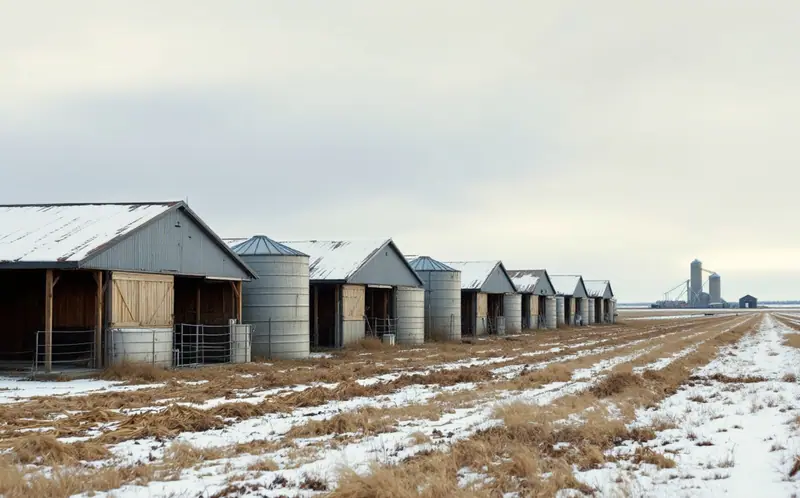
A hog barn can be built almost anywhere with power, water and a road. Yet hog production in Canada has never been spread evenly. It has gathered in southern Manitoba, in parts of Quebec and in southwestern Ontario, with growth in Alberta and Saskatchewan, while other areas with plenty of farmland raise few pigs. The reasons are mostly economic, and they show up in the cost of a pig from weaning to market.
This page sets out the main factors, then puts round illustrative numbers on them.
Feed grain
Feed makes up the largest share of the cost of raising a market hog, often more than half. The cheapest place to feed a pig is where feed grain is cheap, and feed grain is cheapest where it is plentiful and far from export ports.
For most of the century that rule was bent on the Prairies by the Crow rate, the regulated freight rate on Prairie grain shipped to export positions, later supported by a federal transportation subsidy under the Western Grain Transportation Act. Low statutory freight made it cheap to ship grain out of the region as grain, which held up the farm-gate price of barley and wheat. Feeding that grain to livestock at home was relatively less attractive.
The subsidy ended in 1995, when the Act was repealed and Prairie landowners received a one-time transition payment. Farmers then bore the full cost of rail freight to port. Since the price of grain at a Prairie elevator is roughly the port price minus freight and handling, higher freight meant lower local grain prices. For a grain grower this was a loss. For a hog feeder in Manitoba or Saskatchewan it was a cheaper ration, and the case for turning barley into pork on the Prairies grew stronger.
Packing plants
Hogs are heavy, perishable and costly to haul. A hog farm wants a packing plant within a few hours' drive, and a packer wants a steady supply close by. Modern plants also have high fixed costs, so they need to run full, with two shifts if possible, to keep the cost per head down.
This creates a chicken-and-egg problem. Farmers hesitate to expand without a plant to sell to, and packers hesitate to build without hogs to fill the plant. Regions that solve it together tend to grow quickly. Regions that lose a plant can find that producers have to ship long distances, often across the border into the United States, at extra cost.
Manure and the environment
A large hog operation produces a great deal of manure. Handled well, it is a valuable fertiliser. Handled badly, it can foul water and air and turn neighbours against the barn. Rules on manure storage, spreading and the siting of new barns differ by province and, in Ontario, often by municipality through local bylaws.
These rules shape location as much as grain does. Barns tend to go where there is enough cropland nearby to spread manure at sensible rates, where the rules are clear, and where local opposition is manageable. A region with cheap grain but long, uncertain approvals may still lose investment to one with dearer grain and a faster permit.
Labour
Barns need skilled staff, and packing plants need hundreds of workers each. Rural areas with few people can struggle to fill those jobs, especially in plants where the work is hard and repetitive. Wage rates, housing and the willingness of workers to move all enter the decision about where a new plant goes, and therefore where the hogs that feed it will be raised.
Export markets and prices
Canada produces far more pork than Canadians eat, so prices are set largely by export markets. Pork goes to the United States, to Japan and to other buyers, and live hogs move south to American farms and plants. The exchange rate matters a great deal: a cheaper Canadian dollar, such as the record lows of 1998, raises the Canadian-dollar value of US prices and cushions Canadian producers.
The hog market is also prone to sharp cycles. In late 1998 North American hog prices fell to their lowest levels in decades, and in real terms some of the lowest on record. Expanding production met a shortage of packing capacity in the United States, and export demand weakened as several Asian economies went through a financial crisis. Producers on both sides of the border sold hogs well below the cost of raising them. The episode showed how much a region's fortunes depend on packing space close at hand and on access to more than one market.
A worked cost comparison
The numbers below are round and illustrative. They are not taken from any real farm, and real costs vary widely by barn and year.
| Cost per market hog | Prairie region | Central Canada |
|---|---|---|
| Feed | $70 | $78 |
| Weaner pig or breeding costs | $35 | $35 |
| Labour | $9 | $9 |
| Barn, energy and other overheads | $20 | $22 |
| Manure handling | $3 | $4 |
| Freight to the packing plant | $4 | $2 |
| Total | $141 | $150 |
In this example, cheaper grain gives the Prairie barn an $8 advantage on feed, which outweighs slightly higher freight to a more distant plant. But the advantage is small enough to vanish if the nearest plant closes and hogs must travel much further, or if approvals for new barns take years longer. A $9 difference per hog on a barn shipping 10,000 hogs a year is $90,000, enough to decide where an investor builds.
Putting the pieces together
No single factor decides where hogs are raised. Cheap feed draws production towards grain country. Packing plants pull it towards existing plants and the workers who staff them. Manure rules and neighbours push it away from crowded areas. Export markets and the exchange rate set the price that all of these costs must be measured against.
What changed in the 1990s was the weight on each factor. With the freight subsidy gone, Prairie feed grain became cheaper relative to the rest of the country, tilting new investment westward wherever packing capacity and local rules allowed. The open question for any region is whether it can offer all of the pieces at once: grain, a plant, workers and a clear path to approval.
Related reading on how farms grow and change is collected under farm business and the food and rural economy, and the policy side is gathered on the agri-food policy hub.