Crop insurance in Canada, explained without the jargon
Who pays for crop insurance in Canada, how a farm's coverage is set from its own yields and how a claim is worked out after drought, frost or a flooded spring.
 By Reid Gauthier7 min read
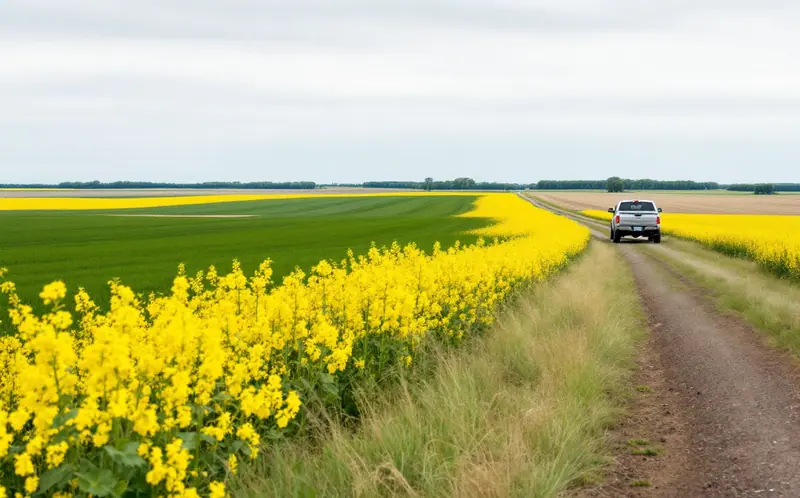
Every spring, before a seed goes in the ground, most grain farmers on the Prairies sign up for crop insurance or renew the policy they already have. It is the oldest piece of Canada's farm safety net and the one farmers deal with most often, yet the paperwork is full of terms that make it look harder than it is. Probable yield, coverage level, insured price, unseeded acreage benefit: each of these has a plain meaning, and once you know them a claim can be worked out on the back of an envelope.
This piece explains who runs crop insurance, who pays for it, how coverage is set and how a claim is calculated, with an illustrative farm to make the numbers concrete.
What it is and who runs it
In federal program language, crop insurance is called AgriInsurance. It is one of the business risk management programs that the federal, provincial and territorial governments run together under their multi-year policy frameworks, alongside AgriStability, AgriInvest and AgriRecovery. Its legal footing is the federal Farm Income Protection Act and the Canada Production Insurance Regulations.
The federal government sets the rules and pays a share, but the provinces design and deliver the plans. That is why a farmer in Alberta and a farmer in Ontario deal with different agencies, different forms and somewhat different products.
| Province | Delivery agency |
|---|---|
| Alberta | Agriculture Financial Services Corporation (AFSC) |
| Saskatchewan | Saskatchewan Crop Insurance Corporation (SCIC) |
| Manitoba | Manitoba Agricultural Services Corporation (MASC) |
| Ontario | Agricorp |
| Quebec | La Financière agricole du Québec |
Other provinces deliver the program through a Crown corporation or a branch of their agriculture department.
AgriInsurance covers production losses caused by natural hazards the farmer cannot control. Agriculture and Agri-Food Canada lists examples such as drought, flood, wind, frost, excessive rain, heat, snow, uncontrolled disease, insect infestations and wildlife. It does not cover low prices, poor management or a crop the farmer chose not to look after.
How the money moves
The cost has two parts: the premium, which pays for expected claims, and administration, which pays for running the agency.
- Premiums are shared 36 per cent by the federal government, 24 per cent by the province and 40 per cent by the producer.
- Administration is paid entirely by governments, 60 per cent federal and 40 per cent provincial. Farmers do not pay it.
So a farmer pays less than half of what the insurance is expected to cost over time. That subsidy is deliberate. Governments would rather support a predictable insurance program than pay large, unplanned disaster amounts after every drought.
The federal government also provides reinsurance to several provinces through a deficit-financing arrangement, so that a province hit by several bad years in a row can still pay claims when its premium reserves run out.
How coverage is set
Three numbers decide how much a farm is covered for.
Probable yield
This is the yield the agency expects the farm to get on a given crop in a normal year. It is built mostly from the farm's own production history, with area averages used where the farm has little history for that crop. A farmer who has grown canola for fifteen years will have a probable yield based largely on those fifteen harvests. A run of good years raises it; a run of bad ones pulls it down.
Coverage level
The farmer chooses what share of the probable yield to insure. In Saskatchewan, for example, the choice runs from 50 to 80 per cent. Higher coverage costs more, and the premium usually rises faster than the coverage, because the insurer is taking on losses that happen more often.
Insured price
The agency sets a price per bushel or per tonne for each crop before the season, based on expected market prices. This is the value used to turn a shortfall in bushels into dollars. In the basic plan the insured price stays fixed for the season if market prices move, although some agencies offer options that adjust it.
Multiply the three together, and add up the acres, and you have the farm's dollar coverage, sometimes called its liability.
A worked claim
Take an illustrative farm with 1,000 acres of canola. All figures here are round numbers for the example, not actual rates in any province.
| Item | Illustrative value |
|---|---|
| Probable yield | 40 bushels an acre |
| Coverage level chosen | 70 per cent |
| Guaranteed yield | 28 bushels an acre |
| Insured acres | 1,000 |
| Guaranteed production | 28,000 bushels |
| Insured price | $13 a bushel |
| Dollar coverage | $364,000 |
Now say a dry summer cuts the crop to 18 bushels an acre, so the farm harvests 18,000 bushels. The shortfall against the guarantee is 28,000 minus 18,000, or 10,000 bushels. At the insured price of $13, the claim is $130,000.
Two things in that example are worth pausing on. First, the farm absorbs the first 30 per cent of its normal yield as its own loss: if it had harvested 30 bushels an acre, a poor crop by its standards, it would receive nothing. That is the deductible built into the coverage level. Second, the claim is paid on bushels, not on revenue. If canola prices had risen sharply because of a drought across the Prairies, the farm's 18,000 bushels might sell for more than expected, but the claim would still be based on the insured price.
What the farm paid
Suppose the total premium for this coverage works out to $25 an acre. The farmer's 40 per cent share is $10 an acre, or $10,000 across the farm. Governments pay the other $15,000, plus the agency's running costs. In a normal year the farm pays $10,000 and collects nothing. In the drought year above, it collects $130,000. Over many years and many farms, the premiums are set so that claims and premiums roughly balance.
Grade, hail and unseeded acres
Crop insurance has several add-ons and special benefits that matter as much as the basic yield coverage.
Quality
Frost, disease or rain at harvest can leave a crop that weighs enough but grades poorly. Many plans adjust the harvested production for quality, so that downgraded grain counts for less than full value when the claim is calculated.
Hail
Hail is the classic spot loss: it can flatten one quarter section and leave the next untouched. Because whole-farm yield coverage may not pay for a loss on a few fields, hail is usually insured separately. In Alberta, AFSC offers a Hail Endorsement that can be added to an annual crop insurance policy, as well as stand-alone Straight Hail Insurance, which pays on damaged acres once the loss reaches 10 per cent. In Manitoba, MASC sells hail coverage that is fully commercial and not subsidized by governments, and losses have to be reported within three business days. Private and mutual hail insurers also operate across the Prairies.
Unseeded acreage
Some springs are so wet that fields cannot be planted. The Prairie agencies offer coverage for unseeded acreage, paying a fixed amount per acre for land that the farmer intended to seed but could not because of excess moisture or flooding by a set date. In Saskatchewan that date is June 20. The benefit is modest compared with the value of a crop, but it pays for some of the costs already incurred: land rent, taxes, fertilizer already applied, and weed control on the idle field.
The calendar
Crop insurance runs on a fixed cycle. Farmers apply or change their coverage before a spring deadline, report what they actually seeded early in the summer, report losses promptly when they happen, and declare their harvested production after harvest. Missing the seeded acreage report or the production declaration can reduce or void a claim, which is why most agencies send reminders and why many farmers keep a folder for the insurance paperwork alone.
Common questions
Is crop insurance the same as AgriStability?
No. Crop insurance pays on lost production of a specific crop. AgriStability pays on a large drop in the margin of the whole farm, which can come from low prices or high costs as well as poor yields. The two work together, and their history is set out in our short history of farm risk management programs.
Do lenders or landlords care about it?
Often. A farm with insurance in place has a floor under its revenue in a disaster year, which makes it easier to plan cash flow. Land rent and purchase decisions, discussed in what drives farmland values, are made against that background.
Why does probable yield fall after bad years?
Because it is built from the farm's own history. Several drought years in a row reduce it, which in turn lowers the coverage just when the farm may need it most. This is one of the most common complaints about yield-based insurance.
For more on farm finances and risk, the farm business issue page collects related explainers, and Agriculture and Agri-Food Canada's AgriInsurance page links to each provincial agency. A useful habit for any farmer reviewing coverage is to work out, before seeding, the yield at which a claim would start. That single number tells you how much of a bad year you are carrying yourself.

Reid Gauthier
Reid lives in Brandon, Manitoba, among grain elevators and feedlots. He writes about livestock and grain markets, feed costs and how prices are discovered.