Contract cleaning, explained for small food businesses
Should a small food business clean with its own staff, hire the work out, or split it? A look at the hidden costs and who carries the risk.
 By Duncan Strathearn7 min read
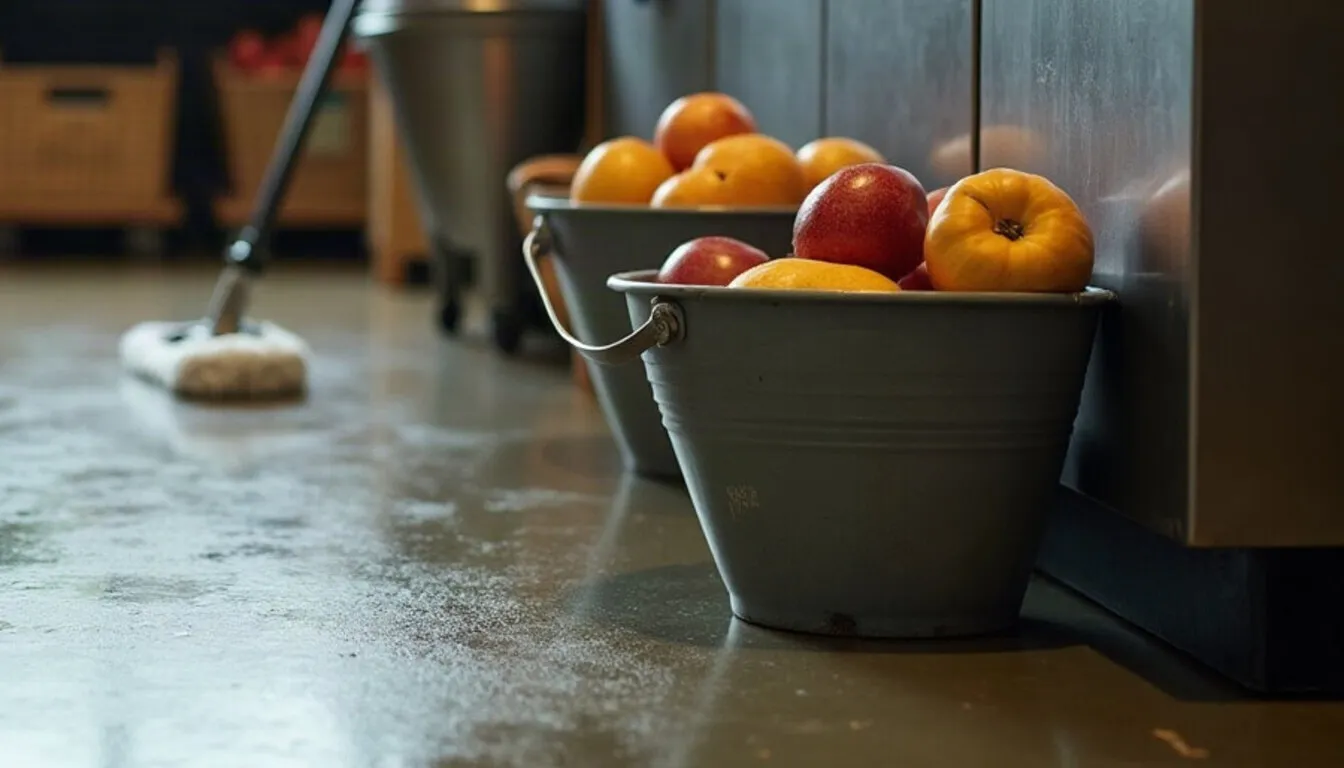
At closing time in a small farm store, the till is counted, the lights in the bakery case go off, and somebody still has to scrub the deli slicer, mop the floor by the cooler door and wipe every handle a customer touched that day. Owners in a damp, mild coastal region such as western Washington know the extra trouble of mud and wet boots tracked in through a long rainy season. Local pages for a cleaning company Olympia WA business owners might call are one place to see how such work is usually divided between routine visits and periodic jobs.
The economic question is simple to state and harder to answer: should a small food business clean with its own staff, hire the work out, or split it? This piece sets out the terms, the costs that hide inside each choice and who carries the risk when cleaning slips. It explains the trade-offs; it is not a quote, a recommendation of any firm or a guide to food safety rules, which vary by place and belong with the local health authority.
What "cleaning" means in a food business
The word is used loosely, so a definition helps. In a food business, cleaning usually means removing visible dirt, grease and food residue from surfaces, floors and equipment. Sanitizing is the further step of reducing germs on a surface that is already clean, and it only works properly on a surface that has been cleaned first.
The distinction matters for the economics because the two tasks are often done by different people. Food contact surfaces, such as slicers, prep tables and the inside of a display case, are commonly handled by the kitchen or counter staff during and after each shift, because they know the equipment and the timing. The rest of the building is another matter: floors, washrooms, windows, offices, break rooms, entry mats, carpeted areas in a customer space and the high places nobody looks at until an inspector does. That second group is where contract cleaning firms usually come in.
So the decision is rarely "outsource everything" or "do everything". It is a question of where to draw the line between the work that has to stay with the people who run the food line and the work that could go to someone else.
What it costs and where the costs hide
The visible cost of in-house cleaning is wages. The less visible costs are larger than most owners expect, and they fall into a few groups.
- Hours at the wrong time of day. Closing cleans happen when staff are tired and the overtime clock is running. An hour of mopping at the end of a long shift is an hour that could not go to baking, stocking or serving.
- Supplies and equipment. Chemicals, mops, floor machines and carpet extractors have to be bought, stored safely and replaced. A small business may own a machine it uses twice a year.
- Training and turnover. Every new hire has to learn which product goes where and in what dilution. In businesses with high staff turnover, that training never really ends.
- The skipped task. The most expensive cleaning is often the one that did not happen: the drain left too long, the cooler gasket never wiped, the grease building up behind a fryer. Those costs appear later as pests, odours, spoiled stock or a repair bill.
Contract cleaning has its own costs. There is the fee itself, the time spent agreeing a scope of work, the need to give an outside crew access to the building after hours, and the risk that the scope written on paper does not match what the business actually needs.
Back-of-the-envelope. Say an illustrative farm store spends 8 hours of staff time a week on the closing clean of floors, washrooms and the customer area, valued at a round 25 dollars an hour. That is 200 dollars a week, or about 10,400 dollars over 52 weeks. If an outside crew took over half of those hours, the store would free 4 hours a week, or about 208 hours a year, for baking, stocking or serving. Whether that is worth doing depends on what the contract costs and what those hours earn when they go back into the business. These are round illustrative numbers, not data from any real business.
The calculation is deliberately incomplete, and that is the point. The fee is easy to compare with wages. The harder part is putting a value on the hours freed and on the tasks that stop being skipped.
Who carries the risk
When cleaning goes wrong in a food business, the cost does not stay with whoever held the mop. It moves along the chain.
The owner carries most of it. A failed inspection, a customer complaint about a washroom or a pest problem lands on the business licence and the reputation, not on the employee or the contractor. That is true whether the work was done in-house or bought in, which is why the scope of any outside arrangement needs to be written down clearly and checked in practice.
Staff carry a share in a quieter way. Cleaning chemicals, wet floors and lifting buckets are a source of workplace injuries, and in a small business the same few people may do every closing shift. Moving the heavier periodic jobs, such as deep floor cleaning or carpet extraction in an office or customer area, to people with the right equipment can reduce that load. Rules on workplace safety vary by province and state, so the details are a matter for the relevant authority, not for this article.
Landlords and tenants split risk too. A food business that leases its building may have cleaning and upkeep duties written into the lease, and damage from neglected drains, flooring or carpets can turn into a dispute at the end of the term. A lawyer or the landlord is the right person to ask about who owes what; the economic point is that cleaning is partly a way of protecting a deposit and a building.
Finally, customers carry risk they cannot see, which is the reason health authorities take an interest at all. A business that treats cleaning as a cost to minimize rather than a cost to manage is quietly shifting risk onto the people who buy its food.
What to weigh before deciding
A comparison table helps separate the options. The cost bands below are relative, not prices.
| Option | Up-front cost | Hidden cost risk | Suits |
|---|---|---|---|
| All in-house | Low (supplies only) | High: tired staff, skipped tasks, training | Very small shops with stable staff |
| Contract for the building, staff for food contact surfaces | Moderate | Low to moderate: needs a clear scope | Farm stores, bakeries, small processors |
| Contract for periodic deep cleans only | Low to moderate | Moderate: daily standard still rests on staff | Seasonal businesses, markets, commissary kitchens |
Beyond the table, a few questions tend to settle the matter:
- Which tasks need food knowledge, and which need equipment? Food contact surfaces usually stay with staff; floors, carpets, washrooms and windows are the most common tasks to hand over.
- When is the building empty? An outside crew needs a window of time and a way in. If the store is busy until late and opens early, that window may be short.
- How seasonal is the business? A farm market that is packed in late summer and quiet in winter may want a flexible arrangement rather than one fixed routine all year.
- What does a written scope include? Before any agreement, list each area, how often it is cleaned and what "done" means. A good cleaning company will usually walk the building and ask these questions itself.
- What do the local rules require? Food safety and sanitation requirements come from the local health department, and an owner should check them directly rather than rely on a contractor or an article.
The same arithmetic at a different scale
For a roadside stand or a one-person bakery, the numbers rarely support a contract for daily work. The owner cleans as part of the job, and an outside crew might come in a few times a year for a deep clean of floors and fixtures. The trade-off there is mostly about time and the owner's own back.
For a small processor, a farm store with a café or a commercial kitchen shared by several producers, the balance shifts. The building is larger, the hours are longer, and several people use the same washrooms, floors and storage areas. In that setting, the hidden costs of in-house cleaning grow faster than the fee for outside help, because no single person owns the job.
The comparison holds on both sides of the border. A food business in Ontario and one in Washington face the same basic arithmetic: hours, supplies, risk and the cost of the skipped task. What differs is the set of local rules and the weather tracked in on customers' boots.
The trade-off in one line
In-house cleaning looks cheaper until the hidden hours, skipped tasks and staff wear are counted, and contract cleaning looks expensive until the same is done for the alternative. Write down every task, decide which ones need food knowledge and which need equipment, and price only the second group before choosing.

Duncan Strathearn
Duncan lives in Kingston, Ontario, and follows agricultural trade talks, tariff schedules and the policy frameworks that sit behind them. He reads trade agreements so readers do not have to.